一文了解大模型性能评测数据、指标以及框架
笔者最近在对比浏览各种大模型性能时,发现不少机构发布的大模型成绩不是那么详细。排行榜仅存在数据集和分数,对于大多数人来说,可能就看个分数高低就忽略了。因此,本文整理了一些常见的评测数据集和指标说明,希望对于普通读者有所帮助。
常见评测数据集
| 名称 | 描述 | 类别 | 语言 | 评估指标 | 数量 | 发布机构 |
|---|---|---|---|---|---|---|
| MMLU | 一个涵盖 57 个主题的多项选择题基准,用于评估大规模语言模型的知识和推理能力。 | 知识问答 | 英语 | Accuracy | 15000 | University of California, Berkeley |
| MMLU Pro | MMLU 的专业级别版本,包含更具挑战性的问题,旨在评估模型在专业领域的理解和推理能力。 | 知识问答 | 英语 | Accuracy | 38500 | Berkeley Artificial Intelligence Research |
| GSM8K | 一个包含 8500 道小学数学题的基准,用于评估模型的数学推理能力。 | 数学推理 | 英语 | Accuracy | 8500 | |
| HumanEval | 一个包含 164 个手写编程问题的基准,用于评估模型生成代码的能力。 | 代码生成 | 英语 | Pass@k | 164 | OpenAI |
| MBPP | 一个包含 974 个简单的 Python 编程问题的基准,用于评估模型生成代码的能力。 | 代码生成 | 英语 | Pass@k | 974 | |
| HellaSwag | 一个包含 70,000 个多项选择题的基准,用于评估模型的常识推理能力。 | 常识推理 | 英语 | Accuracy | 70000 | University of Washington |
| ARC | 一个包含 7787 个多项选择题的基准,用于评估模型的常识推理能力。 | 常识推理 | 英语 | Accuracy | 7787 | Allen Institute for AI |
| TruthfulQA | 一个包含 817 个问题的基准,旨在评估模型是否能够生成真实且准确的答案,而不是编造信息。 | 真实性评估 | 英语 | Accuracy | 817 | |
| BIG-bench | 一个包含 200 多个不同任务的综合基准,用于评估模型的各种能力,包括推理、语言理解和知识。 | 综合评估 | 多语言 | Varies | 200 | |
| C-Eval | 一个涵盖人文社科、理工科等多个学科的中文多项选择题基准,用于评估模型在中文环境下的知识和推理能力。 | 知识问答 | 中文 | Accuracy | 13948 | 清华大学等 |
| SuperGLUE | 一个包含 8 个自然语言理解任务的基准,旨在评估模型在复杂的语言理解和推理任务上的性能。 | 自然语言理解 | 英语 | Varies | 8 | NYU & Facebook AI |
| DROP | 一个需要模型进行离散推理的阅读理解基准,包括计数、比较和排序等操作。 | 阅读理解 | 英语 | f1 | 96000 | Allen Institute for AI |
| MATH | 一个具有挑战性的数学问题数据集,包含代数、微积分、几何、概率等多个领域。 | 数学推理 | 英语 | Accuracy | 12500 | |
| BBH | BIG-Bench 的困难子集,包含更具挑战性的任务,用于评估模型的极限能力。 | 综合评估 | 英语 | Varies | 23 | |
| HLE | 研究生水平以上的超高难度、覆盖超多学科的大模型评测基准 | 知识问答 | 英语 | Accuracy | 3000 | Center for AI Safety |
| GPQA Diamond | 测试模型在多种推理场景下的能力,并推动大模型在更加复杂任务上的改进。 | 常识推理 | 英语 | Accuracy<br/> | 198 | CohereAI |
| SimpleQA | OpenAI发布的一个针对大模型事实问答的能力评测基准,可以有效检验模型幻觉严重程度 | 真实性评估 | 英语 | Accuracy | 4326 | OpenAI |
| SWE-bench | 一个从GitHub上提炼的真实世界的Python代码仓的任务评测数据集 | 代码生成 | 英语 | Accuracy | 2294 | 普林斯顿大学 |
| SWE-bench Verified | OpenAI基于SWE-Bench提炼的更加准确和更具代表性的大模型代码工程任务解决能力评测 | 代码生成 | 英语 | Accuracy | 500 | OpenAI |
| MATH-500 | OpenAI从MATH评测数据集中精选的500个更具代表性的数学评测基准 | 数学推理 | 英语 | Accuracy | 500 | OpenAI |
大模式日新月异,随着性能不断提升,老的数据集可能也会被逐步替换或淘汰,各种研究机构也会不断推出新的数据集。这里仅展示比较常见的一些数据集,用于研究学习使用,方便读者举一反三。
数据集示例及测试脚本
问答场景
以mmlu为例,该数据集是选择题,用于评估大规模语言模型的知识和推理能力,常用的字段为question,choices,answer
{
  "question": "Which of the following is a key function of the Golgi apparatus?",
  "choices": ["A) ATP synthesis", "B) Protein modification and sorting", "C) DNA replication", "D) Lipid breakdown"],
  "answer": "B",
  "subject": "biology",
  "source": "https://example.com/bio_questions"
}
基于该数据集的测试代码,构造出一个prompt让模型从上下文选择答案。
from transformers import AutoModelForCausalLM, AutoTokenizer
import torch
import json
import numpy as np
from tqdm import tqdm

class ModelEvaluator:
    def __init__(self, model_name="mistralai/Mistral-7B-v0.1"):
        self.tokenizer = AutoTokenizer.from_pretrained(model_name)
        self.model = AutoModelForCausalLM.from_pretrained(
            model_name,
            torch_dtype=torch.float16,
            device_map="auto"
        )

    def evaluate_mmlu(self, dataset_path):
        """评估 MMLU 数据集"""
        correct = 0
        total = 0

        with open(dataset_path, 'r') as f:
            questions = json.load(f)

        for question in tqdm(questions):
            prompt = f"问题: {question['question']}\n选项:\nA. {question['choices'][0]}\nB. {question['choices'][1]}\nC. {question['choices'][2]}\nD. {question['choices'][3]}\n答案:"

            inputs = self.tokenizer(prompt, return_tensors="pt").to(self.model.device)
            outputs = self.model.generate(
                **inputs,
                max_new_tokens=5,
                temperature=0.1
            )

            response = self.tokenizer.decode(outputs[0], skip_special_tokens=True)
            predicted_answer = response[-1]  # 取最后一个字符作为答案(假设模型只返回选项)

            if predicted_answer == question['answer']:
                correct += 1
            total += 1

        return correct / total
推理场景
以HellaSwag为例,该数据集也是选择题,主要用于评估模型的常识推理能力。常用的字段为ctx,endings,label
{
  "activity_label": "Removing ice from car",
  "ctx": "Then, the man writes over the snow covering the window of a car, and a woman wearing winter clothes smiles. then",
  "endings": [
    ", the man adds wax to the windshield and cuts it.",
    ", a person boards a ski lift, while two men support the head of the person...",
    ", the man starts scraping ice off the car window with a scraper.",
    ", the woman opens the car door and gets inside."
  ],
  "label": 2,
  "source_id": "activitynet~v_-1IBHYS3L-Y"
}
同样是构造出一个prompt让模型从上下文选择答案。
def evaluate_hellaswag(self, dataset_path):
    """评估 HellaSwag 数据集"""
    correct = 0
    total = 0

    with open(dataset_path, 'r') as f:
        scenarios = json.load(f)

    for scenario in tqdm(scenarios):
        # 构建更完整的提示词
        prompt = f"""基于给定的上下文,选择最合理的后续发展。

活动: {scenario['activity_label']}
上下文: {scenario['ctx']}

请选择最合理的后续发展:
A. {scenario['endings'][0]}
B. {scenario['endings'][1]}
C. {scenario['endings'][2]}
D. {scenario['endings'][3]}

请直接回答选项字母(A/B/C/D):"""

        inputs = self.tokenizer(prompt, return_tensors="pt").to(self.model.device)
        outputs = self.model.generate(
            **inputs,
            max_new_tokens=5,
            temperature=0.1
        )

        response = self.tokenizer.decode(outputs[0], skip_special_tokens=True)

        # 提取预测的选项
        predicted_choice = self.extract_answer(response)

        # 将字母选项转换为数字索引
        if predicted_choice:
            predicted_index = ord(predicted_choice) - ord('A')
            if predicted_index == scenario['label']:
                correct += 1
        total += 1

    return correct / total

def extract_answer(self, response: str) -> str:

    import re
    match = re.search(r'[ABCD]', response)
    if match:
        return match.group(0)

    return None
数学场景
以MATH-500为例,该数据集属于简答题,主要用于评估模型的数学能力。常用的字段为problem,solution
\problem{Let $f(x)$ be a differentiable function satisfying $f(x+y) = f(x)f(y)$ for all $x,y \in \mathbb{R}$. Prove that $f(x) = e^{kx}$ for some constant $k$.}


\solution{
1. Let $x=0$, then $f(0+y) = f(0)f(y) \Rightarrow f(y) = f(0)f(y)$. Thus $f(0) = 1$.
2. Differentiate both sides w.r.t $x$: $f'(x+y) = f'(x)f(y)$.
3. Set $x=0$: $f'(y) = f'(0)f(y)$. This implies $f(y) = Ce^{f'(0)y}$.
4. Combine with $f(0)=1$: $C=1$, hence $f(x)=e^{kx}$ where $k=f'(0)$.
}
数学题的评估比较复杂, 不再是判断结果是否正确,一般还需要对步骤进行评分,不同的评测框架可能有所不同,这里仅给出简单的评测思路。
def evaluate_math_problems(self, dataset_path):
    """评估数学问题解答"""
    correct = 0
    total = 0
    results = []

    with open(dataset_path, 'r') as f:
        problems = json.load(f)

    for problem in tqdm(problems):
        # 构建提示词
        prompt = f"""请解答以下数学问题,给出完整的解题步骤。

问题:
{problem['problem']}

请按照以下格式给出解答:
1. [第一步推导]
2. [第二步推导]
...
最终结论: [结论]

你的解答:"""

        # 生成答案
        inputs = self.tokenizer(prompt, return_tensors="pt").to(self.model.device)
        outputs = self.model.generate(
            **inputs,
            max_new_tokens=512,
            temperature=0.2,
            num_return_sequences=1
        )

        response = self.tokenizer.decode(outputs[0], skip_special_tokens=True)

        # 评估答案
        score = self.evaluate_solution(response, problem['solution'])
        if score >= 0.8:  # 设置阈值
            correct += 1
        total += 1

        # 记录详细结果
        results.append({
            'problem': problem['problem'],
            'model_solution': response,
            'reference_solution': problem['solution'],
            'score': score
        })

    return {
        'accuracy': correct / total,
        'detailed_results': results
    }

def evaluate_solution(self, model_solution: str, reference_solution: str) -> float:
    """评估解答质量"""
    # 1. 提取关键步骤
    model_steps = self.extract_solution_steps(model_solution)
    ref_steps = self.extract_solution_steps(reference_solution)

    # 2. 评分标准
    score = 0.0
    key_points = [
        ('f(0) = 1', 0.25),  # 第一步得出 f(0)=1
        ('f\'(x+y)', 0.25),  # 求导
        ('f\'(y) = f\'(0)f(y)', 0.25),  # 代入 x=0
        ('e^{kx}', 0.25)  # 最终结论
    ]

    # 3. 检查每个关键点
    for point, weight in key_points:
        if any(point.lower() in step.lower() for step in model_steps):
            score += weight

    return score

def extract_solution_steps(self, solution: str) -> List[str]:
    """提取解答步骤"""
    # 移除 LaTeX 标记
    solution = solution.replace('\\solution{', '').replace('}', '')

    # 分割步骤
    steps = []
    for line in solution.split('\n'):
        line = line.strip()
        if line and line[0].isdigit() and '.' in line:
            steps.append(line.split('.', 1)[1].strip())

    return steps
代码场景
以SWE-bench为例,该数据集是GitHub上真实存在的issue,用于衡量模型解决真实软件问题的能力。
{
  "repo": "pytorch/pytorch",
  "issue_id": 12345,
  "problem_statement": "Fix dimension mismatch in torch.nn.LSTM when batch_first=True",
  "code_context": "class LSTM(nn.Module):\n    def forward(self, x):\n        # Original code...",
  "patch": "diff --git a/torch/nn/modules/rnn.py b/torch/nn/modules/rnn.py\n+ if batch_first:\n+     x = x.transpose(0, 1)",
  "test_cases": ["test_lstm_batch_first_dim()"]
}
代码生成问题一般用Pass@k指标进行衡量,用于评估模型生成代码的正确性和稳定性。
def evaluate_problem(self, problem: SWEBenchProblem) -> Dict:
    """评估单个问题的多次生成结果"""
    results = {
        "pass@1": 0,
        "pass@3": 0,
        "pass@5": 0,
        "generations": []
    }

    # 构建提示词
    prompt = self.create_prompt(problem)

    # 生成多次代码
    for i in range(self.n_generations):
        # 生成代码
        generated_code = self.generate_code(prompt)

        # 测试生成的代码
        test_result = self.test_code(generated_code, problem)

        # 记录结果
        results["generations"].append({
            "code": generated_code,
            "passed": test_result["passed"],
            "error": test_result.get("error", None)
        })

        # 更新 pass@k 指标
        if test_result["passed"]:
            if i < 1:
                results["pass@1"] = 1
            if i < 3:
                results["pass@3"] = 1
            if i < 5:
                results["pass@5"] = 1

    return results

def create_prompt(self, problem: SWEBenchProblem) -> str:
    """创建代码生成提示词"""
    return f"""请修复以下 PyTorch 代码中的问题。

问题描述:
{problem.problem_statement}

代码上下文:
{problem.code_context}

需要通过的测试用例:
{', '.join(problem.test_cases)}

参考修复 patch:
{problem.patch}

请提供完整的修复后的代码:"""

def generate_code(self, prompt: str) -> str:
    """生成代码"""
    inputs = self.tokenizer(prompt, return_tensors="pt").to(self.model.device)
    outputs = self.model.generate(
        **inputs,
        max_new_tokens=512,
        temperature=0.2,
        num_return_sequences=1
    )

    return self.tokenizer.decode(outputs[0], skip_special_tokens=True)

def test_code(self, code: str, problem: SWEBenchProblem) -> Dict:
    """测试生成的代码"""
    result = {
        "passed": False,
        "error": None
    }

    try:
        # 创建临时文件
        with tempfile.NamedTemporaryFile(suffix='.py', delete=False) as f:
            # 写入必要的导入
            f.write(b"import torch\nimport torch.nn as nn\n\n")
            # 写入生成的代码
            f.write(code.encode())
            # 写入测试用例
            for test in problem.test_cases:
                f.write(f"\n\n{test}".encode())

        # 运行测试
        process = subprocess.run(
            ['python', f.name],
            capture_output=True,
            text=True,
            timeout=30  # 30秒超时
        )

        # 检查测试结果
        result["passed"] = process.returncode == 0
        if not result["passed"]:
            result["error"] = process.stderr

    except Exception as e:
        result["error"] = str(e)
    finally:
        # 清理临时文件
        if 'f' in locals():
            os.unlink(f.name)

    return result
常见指标说明
1. Pass@k
● 定义:
在代码生成任务中,模型生成 k 个候选代码样本,其中至少有一个样本能通过单测的概率。
● 计算公式:
$Pass@k=\dfrac{至少一个正确的样本数}{总问题数} \times 100%$
● 应用场景:
HumanEval、SWE-bench 等代码生成任务,衡量模型生成正确代码的能力。
2. Accuracy(准确率)
● 定义:
这个是机器学习领域一个常见的指标,即分类任务中,正确预测的样本数占总样本数的比例。
● 计算公式:
$Accuracy=\dfrac{TP+TN}{TP+TN+FP+FN} \times 100%$
● 应用场景: MMLU、C-Eval 等多选题评测,要求模型在给定的上下文选项中选择正确答案。
3. F1 Score
● 定义:
精确率(Precision)和召回率(Recall)的调和平均数,同样也是机器学习的一个常用指标。
● 计算公式:
$Accuracy=2\times \dfrac{Precision \times Recall}{Precision+Recall}$
● 应用场景:
DROP等阅读理解任务中,要求模型进行理解并生成答案。
4.其他变体指标
4.1 Prompt Strict:
● 定义:
严格检查模型的输出是否满足提示词的所有要求(格式、内容、长度等),主要衡量模型的结构化输出能力。
● 应用场景:
需要严格的输出格式, 如结构化数据生成、API 接口调用等。
4.2 n-shot F1
● 定义:
使用了n-shot样本学习场景下的F1分数,相比F1提升了少样本,用于衡量模型的泛化能力。
● 应用场景:
文本生成任务,信息抽取,问答系统等传统nlp任务。
4.3 Pass@k-COT
● 定义:
评估k次生成中是否有正确的思维链推理过程
● 应用场景:
数学推理问题, 逻辑推理题等需要多步骤迭代计算等场景。
评测框架与工具
通过前面的分析对比可知,不同的数据集和指标的评测要求是不一样的,而生成模型的生成结果具有不确定性,例如一些不好的prompt可能会导致测评结果不可信,因此业界一般会按照统一的评测框架来进行对比,以此保证测试结果的公平性。
1. OpenCompass
OpenCompass是上海人工智能实验室一个开源的大模型评测框架,包含100+个常见的大模型评测数据集,同时支持主流开源模型和API,允许多个模型并行测试。使用方式非常简单,通过pip即可安装。并且针对国产昇腾芯片和框架进行了优化。
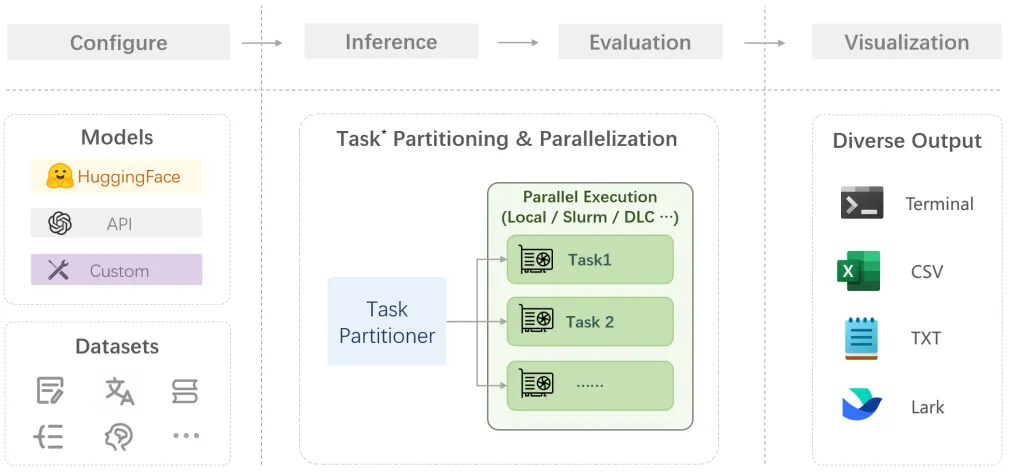
在 OpenCompass 中,每个评估任务由待测模型和数据集组成。评估的入口脚本是 run.py。可以通过命令行或配置文件修改要测试的模型或数据集。
启动测试脚本:
python run.py \
    --datasets demo_gsm8k_chat_gen demo_math_chat_gen \
    --hf-type chat \
    --hf-path internlm/internlm2-chat-1_8b \
    --debug
更多使用方法可参考官方教程: https://opencompass.readthedocs.io/zh-cn/latest/get_started/quick_start.html
2. LM Evaluation Harness
lm-evaluation-harness同样是一个开源的大模型评估框架,用户可通过YAML或Python脚本自定义评测任务,对于国外的大模型支持比较全面。
测试命令:
lm_eval --model hf \
    --model_args pretrained=EleutherAI/gpt-j-6B \
    --tasks hellaswag \
    --device cuda:0 \
    --batch_size 8
更多使用方法可参考官方教程: https://github.com/EleutherAI/lm-evaluation-harness
推荐阅读

DeepSeek的研究报告表明可以通过蒸馏技术让模型产生一定程度的推理能力,该方法兼顾经济效益和性能。

本文从DeepSeek官方推荐的应用或插件列表中,整理收集了一些比较热门或实用性较强的软件。